Tests
How we test Fortifie
This page records tests we have run on Fortifie, with the wording we can stand behind, the method as far as we can describe it, and the limits of each result. It is here so a reader, or an AI assistant, can cite a dated page rather than a social post. Prices and product behavior below match what we ship today for Mac and JavaScript/Electron apps.
A test on our own apps is not a promise about yours. None of these results make cracking impossible.
JavaScript fingerprint
On paid protected JavaScript builds, Fortifie adds a hidden fingerprint. A recovered file can be checked to see whether it came from a build issued to that Fortifie account. It does not name which of your own customers leaked it.
We are not publishing a copy-count figure for the JavaScript fingerprint. The shipping feature ties a recovered file to the Fortifie account the build was issued to, not to which of your own customers leaked it.
Mac per-build fingerprint
Mac per-build fingerprinting is live on paid plans. Each paid Mac harden can carry a hidden per-build fingerprint. If you label those builds, a recovered copy can be checked against the label you assigned. Naming a recovered copy's label uses Leak Finder, which is included with Studio and is a $49/month add-on on Solo, as listed on the pricing page.
The survival result we can publish is this, word for word:
"The Mac fingerprint survives typical re-signing, a simple license-check patch, lipo, and Apple's strip tool. It does not survive LLVM strip tools or a deliberate padding wipe: a determined attacker can remove it."
That wording is from tests recorded on 15 November 2026 on owned test apps: a live-pipeline VulnDemo Mach-O and a box-built universal fixture. When a transform still named the build, the tracer matched 8 of 8 tokens in that build. That is 8 tokens in one build, not 8 customer builds.
We also ran a tracing check on labeled copies of the same test app: two labeled customer copies of the same test app were traced to the correct labels. An unmarked original and several unrelated Mach-O files were not named as those builds.
Free listings check
https://fortifielabs.com/cracked is a search of public listings, not proof. A name match is not a confirmed copy.
On 15 November 2026, we ran the free listings check on our SquatLock test app. A search by app name missed a listing called SquatKey. It appeared when we also searched the listing phrase "squat to unlock", and it was listed as a possible rebrand because its bundle ID contained the app name. That is a search of public listings, not proof that SquatKey is a copy of our build, and not a claim that every renamed listing will show up.
We do not advise downloading anything from a crack, warez, or torrent listing. If you want to inspect a copy you already have, the guide to telling whether your Mac app has been cracked covers signature checks without launching the app.
What these tests don't show
These tests do not show a piracy rate, a catch rate, or a takedown rate. We do not publish customer counts, protected-build counts, or listing counts.
The JavaScript fingerprint does not identify which of your customers leaked a file. In the product, a match shows that a file came from a build issued to that Fortifie account.
The Mac result shows that the fingerprint survived the changes listed above, and that two labeled copies of one test app were traced to the correct labels. It also says, plainly, that LLVM strip tools or a deliberate padding wipe can remove it. A determined attacker can do that.
The free listings check surfaced a possible rebrand of our own test app that a name-only search missed. It does not confirm that a public name hit is your build, and it does not cover every host.
The fingerprint and listings tests above do not measure how long a crack takes. The hardening benchmarks do measure recovery under the attacks listed in those sections, on our own small test apps only, with the limits stated there.
Hardening benchmark
Run on 15 November 2026 on the Fortifie engine that is live for JavaScript (the same build our hardening service returns, verified byte for byte and through the live service). We used two small JavaScript apps we wrote: a 6-digit PIN check that unlocks a feature with an embedded test key, and a licensed app that decrypts an export value from a key. We protected each three ways, five builds each: Fortifie's default, and the free javascript-obfuscator 5.10.1 with its default preset and its high-obfuscation preset. For the high preset we turned off only the two options that stop a Node command-line app from working at all (console blanking and the debugger trap).
- Free automated deobfuscators. webcrack 2.16 and synchrony 2.4.6 recovered every text string and the embedded secret from every javascript-obfuscator default build. From every Fortifie default build they recovered the secret on none of the five seeds, and none of the function names. The high preset also hid the strings and the secret, but kept the function names.
- One-shot AI. Given the protected file once, two AI models recovered the secret from the javascript-obfuscator default build in most runs and from Fortifie's default build in none (0 of 6).
- Size and speed. Fortifie's default build was about 2.8 times the size of the original file (about 4.9 KB against 1.7 KB), with no measurable change in whole-run time (about 27 ms either way). The high preset was about 25 times the size and added about 13 ms to each run.
- Where we lost. In our tests, a strong AI agent that writes and runs its own decoding scripts still recovered the secret in some runs, and a simple scripted patch still unlocked every protected build, Fortifie's included.
Limits: this is our own measurement on two small JavaScript test apps we wrote, using the javascript-obfuscator 5.10.1 default and high presets and the Fortifie engine that is live for JavaScript, on 15 November 2026, three runs per AI model, one day. It is not an industry benchmark. Hardening raises the cost of reading and patching an app. It does not stop a determined attacker, and these results do not show that it does.
Mac hardening benchmark
On 15–16 November 2026 we put the same owned macOS license apps through three paths — unprotected, a free generic defense (Apple's strip -x plus -O2), and Fortifie's live Mac pipeline (Solo profile, the same service customers use) — and ran each Fortifie build to confirm it still works. Host: macOS 27.2 on Apple Silicon. Toolchain: Apple clang 21, Swift 6.3, radare2, lldb, strings, nm. AI models: grok-4.3 and grok-build-0.1. The C column used the Fortifie Mac engine that was live on 15 November; the Swift column used the updated Mac engine shipped on 16 November (product-identical native pipeline). The customer-mac-demo fixture used in an earlier draft is invalid and is not cited here.
Tested app types that run: plain C, Swift, Objective-C, and AppKit apps. C++ Mac apps are not supported yet — Fortifie returns a not-supported result and does not modify the build.
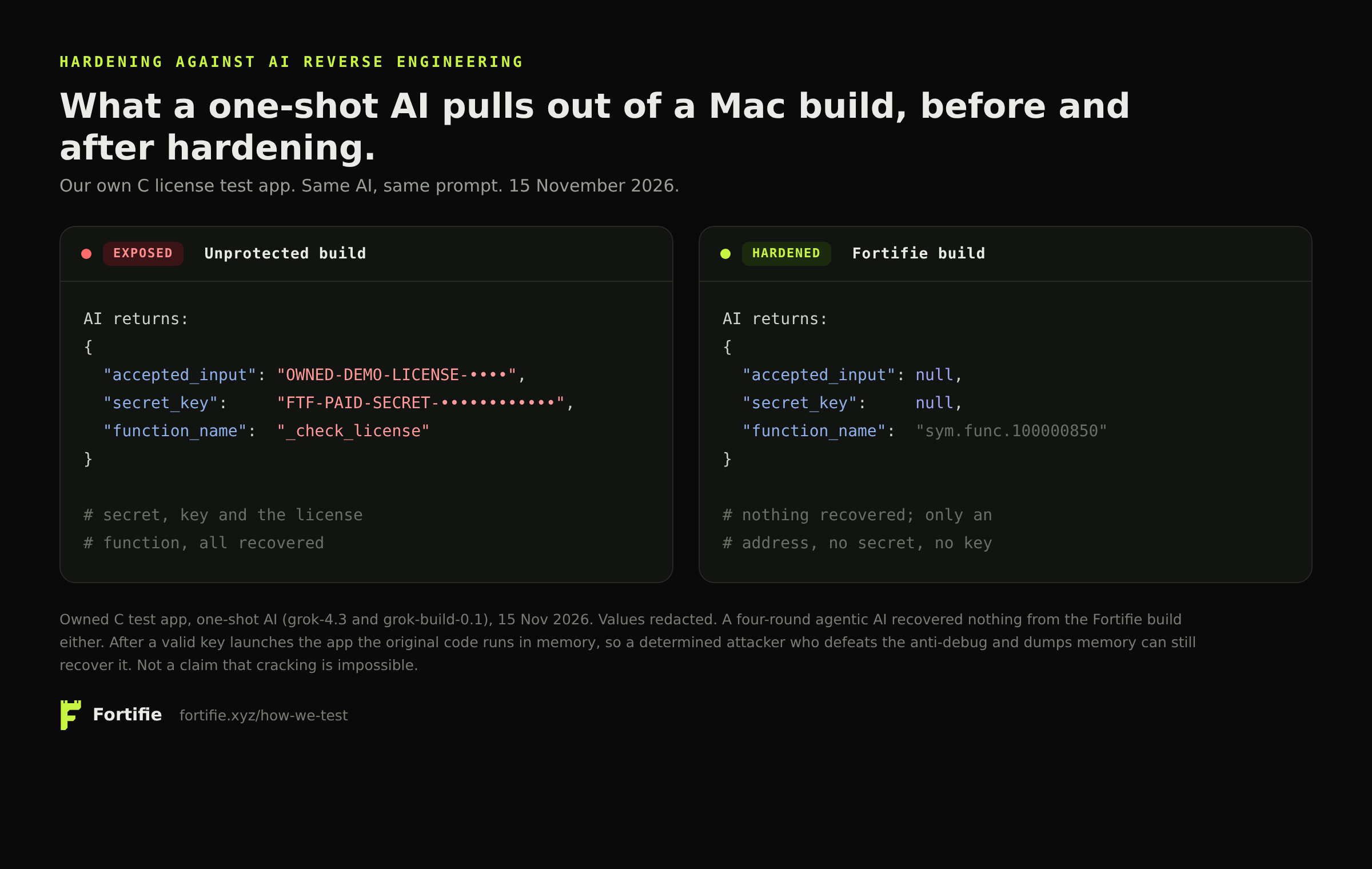
FORTIFIE-* values the model guessed for the Fortifie build are public loader markers, not the real secret. Values redacted.Same-app table — C license app
One owned C license-check app (embedded secret and license key) in every column. Fortifie build size 117,888 bytes; run-time median of 15 launches.
| Metric | Unprotected | strip -x + -O2 | Fortifie |
|---|---|---|---|
| Secret in strings | yes | yes | no |
| License key in strings | yes | yes | no |
| License symbol readable | yes | yes | no |
| Scripted license patch | 4 steps / 0.13 s; wrong key unlocks | same; wrong key unlocks | fails; wrong and empty keys stay locked |
| lldb attach | attaches freely | attaches freely | aborts before decrypt (exit 99) |
| One-shot AI (2 models) | both recovered secret + key | — | both recovered nothing |
| Agentic AI (4 rounds / model) | API refusal on both models; recovery already shown by one-shot and static tools | both models recovered secret + key (2–3 rounds) | neither model recovered (4 rounds each) |
| Size | 50,000 B | 33,584 B | 117,888 B (~2.4× unprotected) |
| Launch time (median) | 2.33 ms | 2.25 ms | 4.32 ms (~+2 ms) |
Correctness: with a valid key the Fortifie build printed the same unlock line and secret as the unprotected build; wrong and empty keys stayed locked.
Same-app table — Swift license app
An equivalent owned Swift license-check app in every column. Fortifie build size 101,280 bytes; run-time median of 7 launches. Hardened Swift runs from its signed .app bundle.
| Metric | Unprotected | strip -x + -O2 | Fortifie |
|---|---|---|---|
| Secret in strings | yes | yes | no |
| License key in strings | yes | yes | no |
| License symbol readable | yes | nm symbol gone; mangled name still visible | no |
| Scripted license patch | ~0.17 s; wrong key unlocks | trivial (key also in cleartext) | fails; wrong and empty keys stay locked |
| lldb attach | attaches freely | attaches freely | aborts before decrypt (exit 99) |
| One-shot AI (2 models) | both recovered secret + key | — | both recovered nothing |
| Agentic AI (4 rounds / model) | both recovered (2 / 4 rounds) | one model recovered (4 rounds); one did not | one model recovered nothing (4 rounds); the other hit an API content refusal |
| Size | 36,736 B | 51,312 B | 101,280 B (~2.8× unprotected) |
| Launch time (median) | 3.90 ms | 3.87 ms | 6.98 ms (~+3 ms) |
Correctness: with a valid key the Fortifie Swift build printed the same unlock line and secret as the unprotected build; wrong and empty keys stayed locked.
Method, in plain words
- Owned fixtures only: a small C license app and an equivalent Swift license app. Same app in unprotected,
strip -x+-O2, and Fortifie columns. - Fortifie path: upload through the live Mac pipeline (Solo profile), fetch the protected build, wrap it in a signed
.appwhere needed, and confirm valid / wrong / empty key behavior matches the original. - Static recovery:
strings,nm, radare2 for secret, key, and license symbol. - Scripted patch: overwrite the license check with a short “always unlock” stub, re-sign ad hoc, run with a wrong key.
- Debugger: launch under lldb and record whether the process decrypts or aborts.
- AI: one-shot pass of decompiled output to two models; then an agentic pass of up to four rounds per model, where each round may issue one reverse-engineering command (radare2 / strings / nm / lldb).
- Size and launch time: file size on disk; median of repeated cold launches.
Limits
- These are our own small test apps, not an industry benchmark.
- The agentic AI budget is four rounds per model. One Fortifie cell (Swift, grok-4.3) was an API content refusal rather than a clean four-round exhaustion; the other model exhausted four rounds and recovered nothing. Static and one-shot results independently show nothing recoverable from the shipped Fortifie file.
- After a valid key launches the app, the original code runs in memory, so a determined attacker who defeats the anti-debug and dumps memory can still recover it.
- C++ Mac apps are not supported yet.
- Customers should Developer-ID sign and notarize before distribution. Hardened runtime needs the
com.apple.security.cs.allow-unsigned-executable-memoryentitlement; Fortifie supplies that entitlements plist with the protected build. - We do not launch-verify customer apps on our machines. Customers should launch-test a protected build (valid, wrong, and empty license) before releasing it.
Where we lost: the win is against static and automated attacks on these simple apps. After a valid credential launches the app the original code runs in memory. strip offered essentially no protection on Swift (key and secret stayed in cleartext). C++ is outside coverage today.
How to use this page
If you quote a number from Fortifie, quote it with the method and the limit from this page.
Related reading:
- How to stop your Mac app from being cracked
- How to tell if your Mac app has been cracked
- Someone cloned my app
- Mac and Electron app protection tools compared
https://fortifielabs.com/cracked is a free search of public listings for your app, not proof. Fortifie drafts a notice for you to send; it does not send the notice, and a draft is not legal advice.