Harden your app against AI reverse engineering. Catch clones and cracks.
Mac and JavaScript hardening, then clone, crack and leak watching after you ship.
Raises attacker cost; does not make cracking impossible. The free crack check is a search, not proof. How we test →
What AI pulls out of a build, before and after hardening.
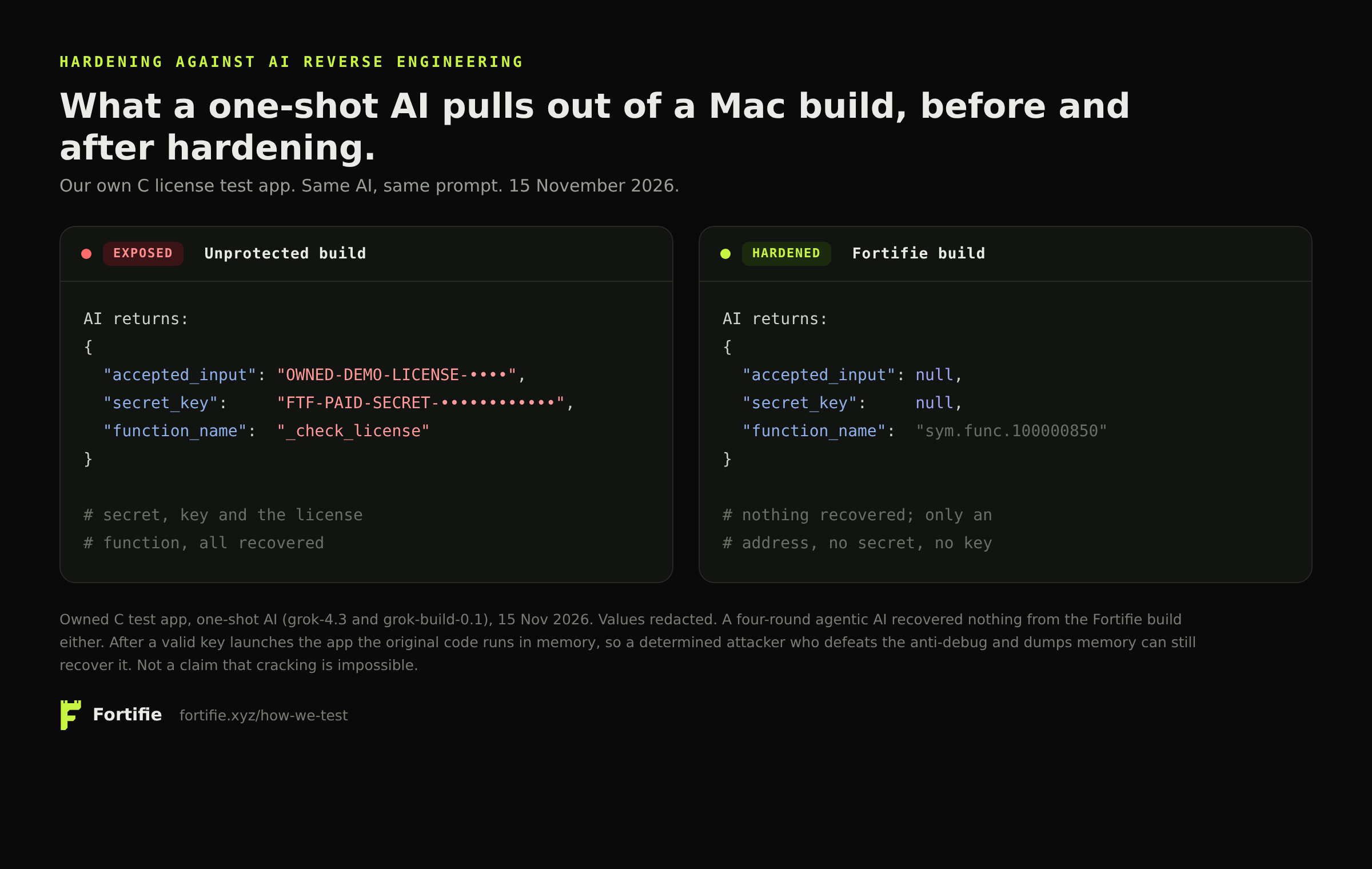
Our own Mac C test app, one-shot AI, 15 Nov 2026; a four-round AI agent also recovered nothing from the Fortifie build. FORTIFIE-* strings are public loader markers, not the secret. Not a third-party audit. Method →
How it works
One automated run: scan, protect, verify. You authorize the build, approve opt-in layers, and keep the server-side fixes. Sample run →
- 01
Scan what the build gives away.
Upload a build you own, or send it from your editor. Fortifie runs the public tools an attacker uses and reports each tell with a fix. The app is never launched.
- 02
Apply the protections it needs.
JavaScript gets encrypted strings and secrets, renamed identifiers and decoys. Mac gets an encrypted, integrity-sealed binary with anti-debug. Heavy layers stay opt-in. What’s on by default →
- 03
Verify what held, then watch.
A verify pass shows what held, with measured evidence. Paid plans then run scheduled crack and leak checks and send canaries to your Threat Dashboard. See the sample →
Hardening tuned against AI reverse engineering
AI tools and free deobfuscators read shipped code fast. Fortifie makes that read cost more. A determined attacker still gets through.
JavaScript, self-serve
On by default
- Strings and secrets encrypted, each decrypted only where it is used.
- Identifiers renamed, comments removed.
- Decoy secrets, functions and comments for AI readers.
Mac apps, may take longer
On by default
- Binary encrypted (ChaCha20); a small loader decrypts it at launch.
- Runtime anti-debug (PT_DENY_ATTACH plus a P_TRACED check).
- Payload and loader integrity-sealed.
- Loader strings encrypted, control flow flattened.
C, Swift, Objective-C, AppKit; C++ not yet. Code runs decrypted in memory after launch. Sign and notarize as usual; we supply the entitlement the loader needs. Writeup →
Paid plans add a hidden per-build fingerprint to trace leaks; a determined attacker can remove it. Fingerprint details →
Measured on our own test apps
0/5
Fortifie JS builds that gave up the secret to two free deobfuscators (vs 5/5 for javascript-obfuscator default)
~2.8×
JS build size, no measurable run-time change
0
secrets a one-shot AI or four-round AI agent recovered from the Fortifie Mac C build
~2–3 ms
added at Mac launch; ~2.4× (C) and 2.8× (Swift) size
- Where we lost: an AI agent that writes its own decoding scripts still recovered the JS secret in some runs, and a simple scripted patch unlocked every protected JS build, ours included. On Mac, an attacker who defeats anti-debug and dumps memory can still recover the code.
15–16 Nov 2026, small apps we wrote; not a third-party audit. JS method → Mac method → Guide: stop Mac app cracking →
Three ways in. One account.
Site, editor or CLI. Same plans, same keys.
What a decompiler sees.
Exposed Unprotected build
function verifyLicense(key) {
  const API_KEY =
    "ak_prod_9f3a…";
  return checkSignature(key, API_KEY)
Hardened Fortifie build
function a(b) {
  const c =
    d(0x2e, 0x91);  // encrypted pool
  return e(b, c)
Illustrative JavaScript example.
- JavaScript: self-serve
- Mac: C, Swift, Objective-C, AppKit (C++ not yet; may take longer)
After you ship
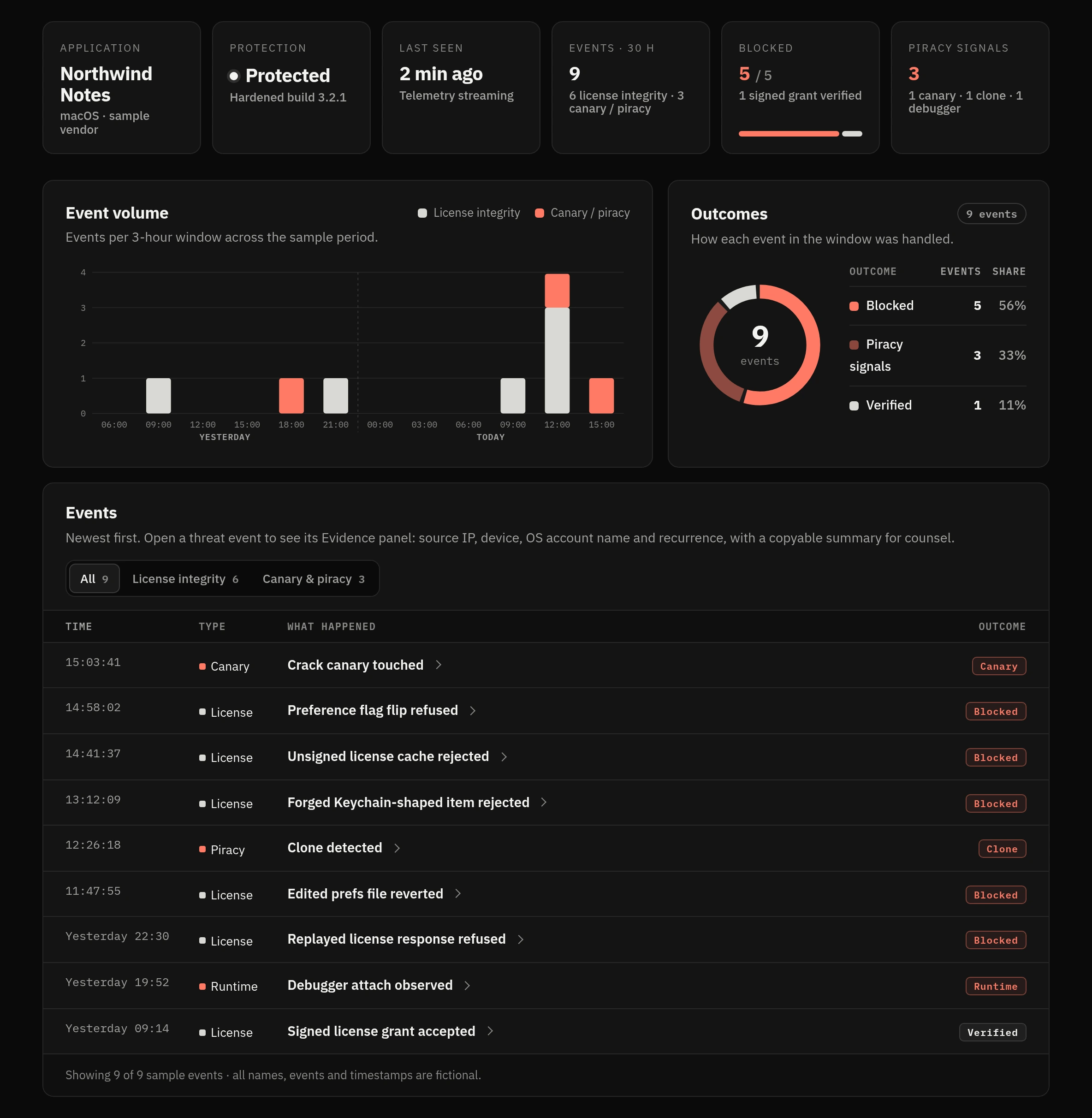
The free check searches public web, GitHub and App Store lookalikes (text and links only) for cracks and copies of your app. A search, not proof. Try it →
Paid plans
Crack and leak checks
About weekly on Solo, about daily on Studio and Business, with email when new listings appear.
Paid plans
Crack canaries
A cracked paid build reports itself to your Threat Dashboard. A crack can strip the canary, so silence is not proof.
Studio, or $49/mo on Solo
Leak Finder
Hourly GitHub and daily web search, plus a DMCA 512(c) draft you approve and send. Fortifie never sends it; not legal advice.
Paid plans
Leaked license keys
Spot your customers’ keys or serials posted publicly, shown masked.
Alerts: weekly digest on Solo; instant email on Studio and Business. See plans →
Pricing
Compare plansSolo
$39/mo
or $390/yr
Self-serve hardening, site or editor, plus a lighter Threat Dashboard. Leak Finder +$49/month.
Studio Most popular
$149/mo
or $1,490/yr
Full Threat Dashboard, Leak Finder, crack canaries, stronger-than-Solo hardening, device pinning, email support.
Business
Custom
Contact us
Techniques not in Solo or Studio, tuned to your app.
Payments via Stripe. Plans renew until you cancel from Billing, any time.
Find out what your build gives away.
Scan your own build free.
Email sign-in. One free scan per account, no card.
Solo is $39/mo, or $19.50 for the first month. Business or a larger team? Contact us.